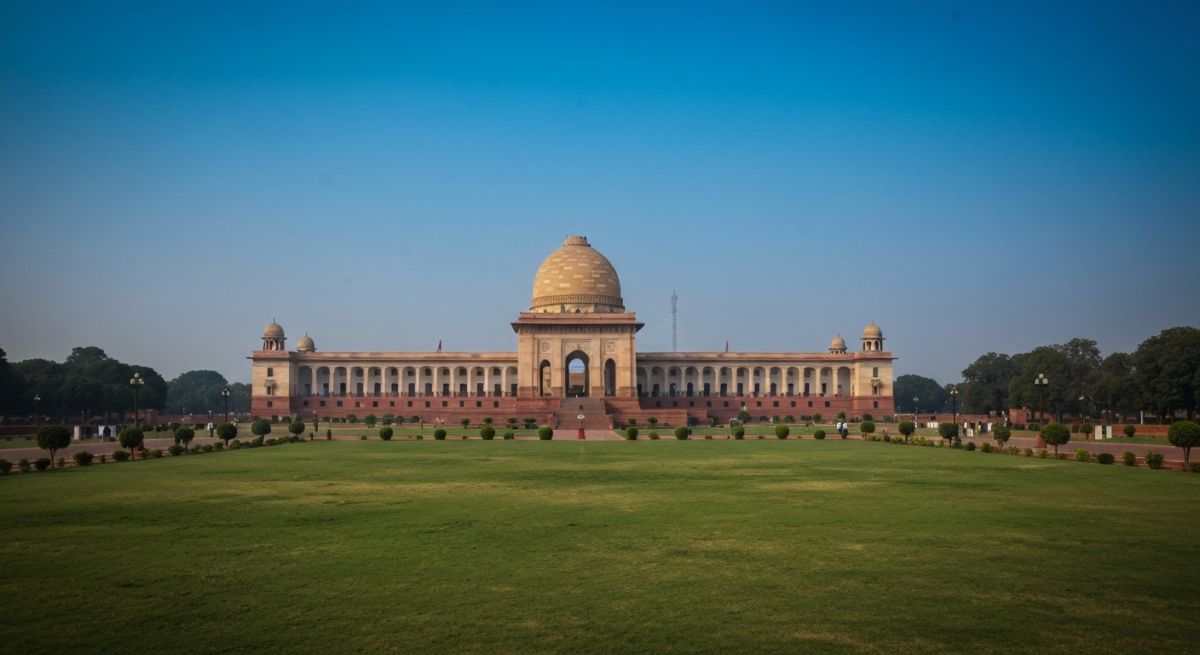
Two chambers, and the gap between them is not decoration. India’s Parliament runs on the Lok Sabha and the Rajya Sabha, and each was built to a different logic. One speaks for the population, head by head. The other speaks for the states, as units of the federation. Miss that distinction and a lot of national politics reads as noise. Grasp it, and suddenly you can follow how a law crawls into being, how a government forms, and how one falls.
Two houses, two design principles
The Lok Sabha, the House of the People, is the directly elected chamber. Voters in territorial constituencies across the country choose its members, and its composition is meant to track population. This is the house that most nearly embodies plain majority rule at the national level. You vote; it reflects you.
The Rajya Sabha, the Council of States, works the other way round. Most of its members are elected not by the general public at all, but by the elected members of the state legislative assemblies. A smaller number are nominated by the President for distinction in fields such as literature, science, art, and social service. The design hands the states a voice in national lawmaking, and it builds in a measure of continuity. The structure and functions of both houses are laid out on the official Parliament of India portal.
Terms and dissolution: the permanence gap
One of the sharpest contrasts is about time — how long members serve, and whether the house itself can be sent packing.
The Lok Sabha is elected for a fixed maximum term, after which general elections follow. It can also be dissolved before that term runs out, for instance when a government loses its majority. By design, it is a house that periodically returns to the electorate in full, all at once.
The Rajya Sabha does the opposite. It is a permanent body, not subject to dissolution. Rather than facing the voters as a bloc, a portion of its members retire on a rolling basis and are replaced through fresh elections, so the chamber renews itself gradually. That staggered rotation is the source of the upper house’s reputation for institutional continuity — it carries experience across the churn of general elections instead of being swept clean by them. Details of membership and rotation are published by the Rajya Sabha secretariat.
Making ordinary laws: closer to equals than you’d think
Here people often assume the elected house simply outranks the other. For most legislation — ordinary bills — that assumption is wrong. On these, the two houses are broadly co-equal. A bill can be introduced in either one, and it generally has to be agreed by both before it becomes law.
What happens when they dig in and reach a genuine deadlock? The Constitution offers an unusual remedy: a joint sitting of both houses, where the combined membership votes together and settles the matter. Because the Lok Sabha is the larger chamber, this mechanism tends to tilt toward the will of the directly elected house. But it is reached for rarely — a fire extinguisher, not a routine tool.
Money bills: where the Lok Sabha is plainly stronger
The real asymmetry shows up with money bills — legislation on matters like taxation and government spending. A money bill can only be introduced in the Lok Sabha. Once it passes there, it goes to the Rajya Sabha, which may discuss it and suggest changes, and must return it within a limited period. What it cannot do is reject or bindingly amend it. The Lok Sabha is then free to take those recommendations or leave them.
The reasoning runs to accountability. Control over the public purse is placed with the house that answers directly to voters. The Speaker of the Lok Sabha certifies whether a bill counts as a money bill, and that certification carries real weight. This financial primacy is one of the most consequential differences between the chambers, and it resurfaces on our business desk every time tax and budget measures move through Parliament.
Confidence in the government: a check only the Lok Sabha holds
India runs a parliamentary system, which means the executive has to keep the confidence of the legislature. But — and this is the crux — of the Lok Sabha specifically. The council of ministers is collectively responsible to the House of the People. A government that loses a vote of no-confidence there is expected to resign. The Rajya Sabha, for all its legislative heft, simply cannot topple a government this way.
So the two chambers answer two different questions. The arithmetic of the Lok Sabha decides who governs. The arithmetic of the Rajya Sabha decides how smoothly that government can actually legislate. A ruling coalition can command the lower house and still be forced to bargain in the upper one to move its agenda — a tug-of-war that colours much of what gets reported in our politics section.
Special powers of the Rajya Sabha
It would be a mistake to file the upper house away as a mere reviewing chamber. It holds a few powers the Lok Sabha does not. As the house that stands for the states, the Rajya Sabha can, by a special majority, authorise Parliament to legislate on a subject otherwise reserved for the states when it judges that to be in the national interest. It also has a role in enabling the creation of certain all-India services. Both provisions flow from its federal character. On questions that touch the delicate balance between the Union and the states, it makes sense that the chamber speaking for the states gets a distinctive say.
Presiding officers and everyday functioning
Even the top jobs differ. The Lok Sabha elects a Speaker from among its own members to preside over its business. The Rajya Sabha is chaired by the Vice-President of India, who serves as its ex-officio Chairman, while a Deputy Chairman is elected from within the house. These presiding officers regulate debate, keep order, and hand down procedural rulings that can quietly decide a bill’s fate — the Speaker’s power to certify money bills being the obvious example.
Why the two-house design matters
Put the differences side by side and a deliberate balance emerges. The Lok Sabha delivers democratic responsiveness: directly elected, dissolvable, in control of money, and the decider of who governs. The Rajya Sabha delivers stability and a federal voice: permanent, gradually renewing, representative of the states, a chamber of second thought on legislation. Neither is simply superior to the other. Each is strongest exactly where its design meant it to be.
Once that map is in your head, national debates get much easier to read. When a contentious bill stalls, when a government’s survival hangs on a vote, when a tax measure suddenly races through — the outcome usually turns on which house holds the relevant power. For the authoritative text on procedure and composition, readers can consult the official portals of the Parliament of India and the Rajya Sabha.