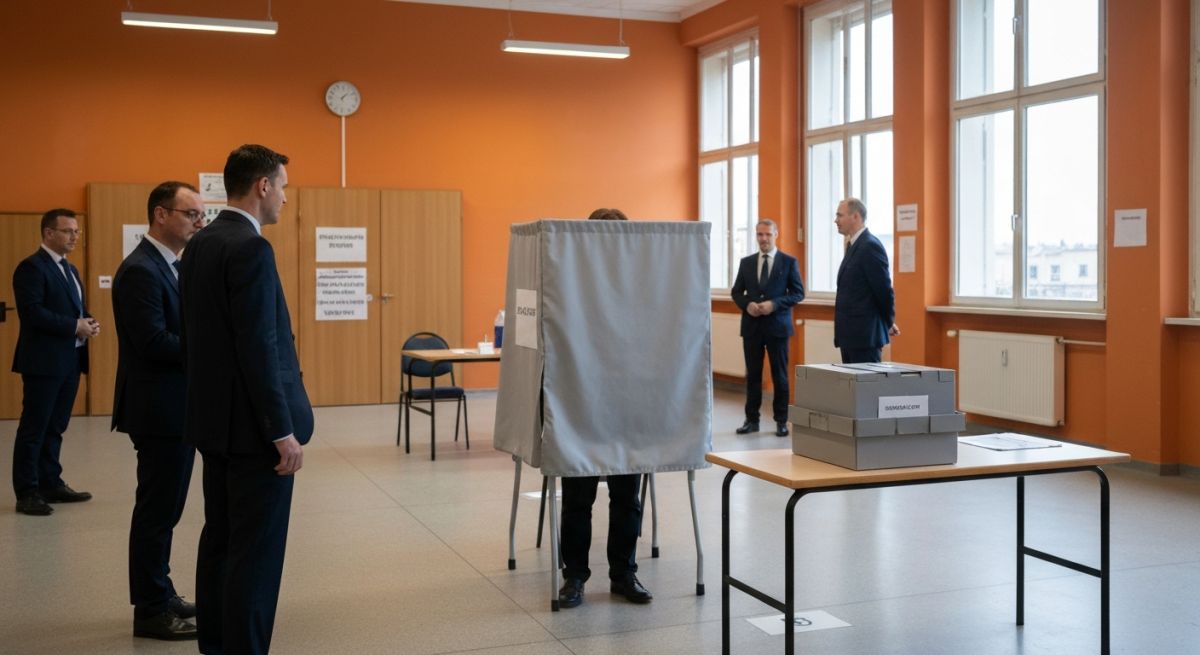
Watch what happens the day India’s election dates are announced. Ministers stop unveiling new schemes. Government advertisements vanish from the hoardings and the front pages. Campaign speeches get combed, sentence by sentence, for a word out of place. Nobody passed a fresh law that morning — nothing in the statute book changed overnight. What kicked in is a document called the Model Code of Conduct, a set of rules that governs how parties, candidates and governments must behave the moment an election is set in motion.
What the Model Code actually is
The Model Code of Conduct — the MCC — is a body of guidelines issued by the Election Commission of India (ECI) for the conduct of political parties and candidates during elections. The aim is simple to state and hard to guarantee: keep the contest fair. Stop the party in power from leaning on its position. Keep campaigning from lighting social fires. Hold the field level for everyone who has chosen to stand.
And here is the part that trips people up. The MCC is not a law passed by Parliament. It grew out of consensus among the political parties themselves, who agreed, over time, to bind their own conduct to a shared set of norms. Its authority rests on that agreement — and on the Election Commission’s constitutional mandate to superintend elections — rather than on any dedicated statute written for the purpose.
When it kicks in and when it ends
The code takes effect the instant the Election Commission announces the schedule for an election, and it holds until the electoral process is complete. That window often runs several weeks. Government does not stop during those weeks — the everyday machinery keeps turning — but ministers and officials suddenly operate under tight restrictions on anything that might tilt a voter.
The main things it forbids
The MCC reaches across a wide sweep of behaviour. Its best-known provisions, though, cluster into a handful of groups.
No misuse of office. The ruling party, at the Centre or in a state, must not press official machinery into campaign service. Government vehicles, staff, buildings — none of them can be turned into campaign assets, and public money cannot be spent on advertisements trumpeting the achievements of the party in power.
No new sweeteners. Once the code is live, governments are barred from announcing new schemes, financial grants, or promises of projects that could look like bribing the electorate. Foundation stones for new works are frozen. Fresh appointments in government are frozen too. The point is to stop a government from reaching into the treasury to buy goodwill in the final stretch.
No appeals to division. Parties and candidates must not fish for votes by appealing to caste or communal sentiment, must not use places of worship as campaign platforms, and must steer clear of anything that could deepen tensions between communities. Personal attacks and unverified allegations against opponents are discouraged. Criticism is meant to stay on policies and records — on what a rival has done, not on rumours about who they are.
Order on the ground. The code sets expectations for peaceful campaigning. Rallies and processions need the cooperation of local authorities, meetings should be cleared in advance where that is required, and every party’s right to hold its events without disruption is protected — including the events of parties you cannot stand.
Rules for polling day itself
The MCC also governs the tense final hours. A mandated silence period falls before voting, during which public campaigning and the display of election matter must stop, handing voters a stretch of quiet in which to make up their minds. On polling day, parties may set up booths near polling stations only within strict limits, and nothing may be done to obstruct or intimidate a voter. The purpose runs through all of it: the act of voting should be calm, and free of pressure.
How it is enforced without being a law
Because the MCC is not statutory, breaking it is not, by itself, a criminal offence — not in the way that bribery under electoral law is. This is the point most people get wrong. So what can the Election Commission actually do? Plenty. It can investigate complaints, issue notices demanding explanations, order offending material taken down, reprimand or censure those responsible, and in serious cases bar a campaigner from the trail for a stretch.
Many acts the code frames in moral language also overlap with real offences — under the Representation of the People Act, whose text is published on the government’s India Code repository, and under the penal law — and those can be taken to court and prosecuted. Enforcement, in other words, runs on two tracks at once. The Commission’s own moral and administrative pressure on one. The ordinary legal system, for conduct that crosses into outright illegality, on the other. And the Commission’s sharpest tool is frequently the plainest: publicity, and the threat of more of it, which parties dread in the middle of a campaign.
Why a voluntary code carries real weight
It does seem odd on its face — a set of voluntary guidelines steering the conduct of an entire political class. Part of the answer is history. The code grew out of repeated agreements between parties across decades, so it carries the legitimacy of consensus rather than of decree. Part of it is institutional: the Election Commission is an independent constitutional authority, and its rulings during an election are hard to brush aside. And part of it is coldly practical. A party caught flouting the code mid-campaign invites a public rebuke at the precise moment it is straining hardest for the voters’ trust.
The Commission has, over the years, stretched the code’s reach into new territory — including guidance on conduct on social media and online campaigning, a nod to how much of an election is now fought on a screen.
The common criticisms
The MCC has its critics, and they are not easily dismissed. Some argue that without statutory teeth, the penalties are too soft to deter a determined offender, and there have been calls to hand parts of the code the force of law. Others counter from the opposite direction: the freeze on new schemes and appointments can stall legitimate governance for weeks at a time. The Commission has generally resisted converting the whole code into statute, arguing that a flexible, consensus-based instrument can be brought to bear faster than a court case and can bend to the endless variety of situations a rigid law would miss. The electoral laws that sit alongside the code are administered under the framework of the Legislative Department of the Ministry of Law and Justice.
The bottom line
Think of the Model Code of Conduct as the etiquette of a fair election, with an independent referee standing behind it. It does not replace election law. It does not, on its own, send anyone to jail. What it does is rein in the natural advantages of incumbency, keep campaign rhetoric inside some kind of boundary, and remind everyone that an election season runs by shared rules rather than by whoever holds the most power. For a voter, knowing what the code forbids is what makes it possible to spot the moment a line gets crossed — and to understand what the Election Commission can, and cannot, do about it.
For more on how India’s democratic institutions work, visit our Politics section.